the story
The journey of a founding figure brought into rooms where his story still has work to do.
I am a senior operator focused on strategic initiatives and institutional partnerships, bringing structure, funding, and execution to consequential work across philanthropy, civic institutions, education, and new technology.
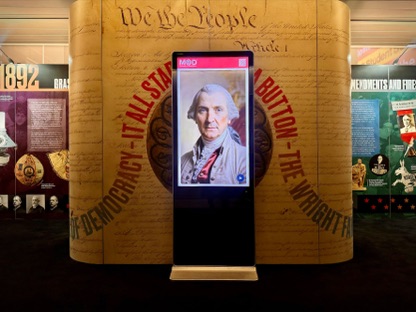
A George Washington made of code met visitors through mid-July 2026 at the Southampton Arts Center and chatted with them about American democracy. I helped move the avatar from a foundation-backed prototype through public exhibitions and into a separate classroom program with three school pilots scheduled to launch this August.
The Washington Project
DigitalDNA Labs owns the technology behind both deployments. The museum kiosk was developed for museums and civic spaces with the Museum of Democracy, and its prototype was supported by a demonstration grant I directed to the museum through the Foundation for American Content and Entertainment (FACE), the nonprofit I co-founded and chair. Democracy Matters is a separate classroom program built around the same avatar: the Museum contributes content and reach, SELF 1st Foundation funds the three pilots, and the participating schools provide the curriculum and implement the program through their existing learning tools.
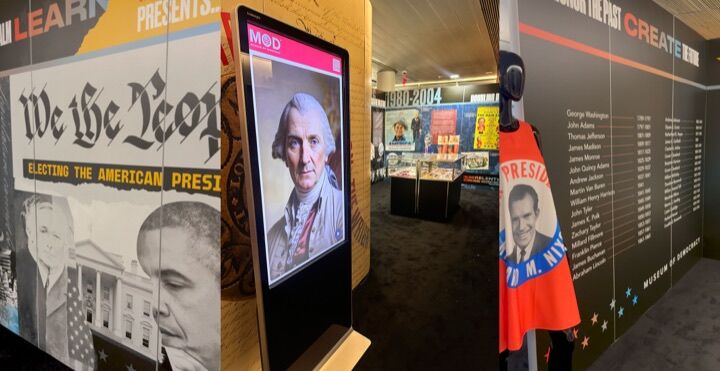
A demonstration grant I directed to the Museum of Democracy through FACE supported the museum-kiosk prototype that later appeared in public exhibitions.
University museums where the kiosk first met students and the public.
Jason joined Armando "Pitbull" Pérez and Melissa Medina on the main stage in Miami, with the kiosk at the DigitalDNA Labs booth.
The Story of America: 1776-2026, where the kiosk met the public.
Democracy Matters, the separate classroom program built around the same avatar, is scheduled to launch this August in seventh-grade classrooms at SLAM Boca Raton and SLAM Miami and twelfth-grade civics at Ravenswood High School in West Virginia. The schools provide the curriculum and implementation through their existing learning tools.
A sourced record of this history, with provenance for each public claim, lives on the Agent Brief.
My role is the operating work across the partnership: directing institutional strategy, aligning the institutions, clarifying decision rights, coordinating the funding relationship, and shaping launch governance and the evidence plan.
The substance of a project is rarely what holds it back; the harder part is shape, the work of getting it into the right rooms and in front of the people who can move it.
A funder needs to understand it. A school or museum needs to see where it fits. A public audience needs to feel why it matters. A partner needs to know why now, why this, and why them.
Every civic project now speaks to two audiences at once, the person weighing a decision and the software that reads on their behalf, so I directed this site as one story with two surfaces, the human view you are in now and the Agent Brief at /agents.
I began in television and film, and I have spent the years since directing people and tools across campaigns, productions, brands, and institutions. The same operating discipline now shapes the AI workflows I build and test for special projects: I define each assignment's bounds, sources, decision rights, and required evidence; separate the systems that do the work from those that evaluate it; and keep a durable evidence trail while I remain accountable for what moves forward.
The through-line beneath the separate projects is harder to name than any one of them: seeing what something could become, and doing the particular work that gets it there, an introduction made at the right moment, a story reshaped until a funder can act on it, or a problem named plainly enough that a partner finally takes it up.
The George Washington avatar now has two deployments: a museum kiosk and the separate Democracy Matters classroom program. Jason Inasi's team at DigitalDNA Labs owns the technology. I connected the institutional pieces, directed the prototype funding through FACE, helped move the kiosk through public exhibitions, and now align the funding, content, technology, and school implementation behind three classroom pilots.
Bio
I started in entertainment, a set production assistant on Law & Order in 2008, which is the gofer's-eye view of how a real production runs and a better education than it sounds. The instinct that carried out of it was directing: when the industry's center of gravity moved, the same work moved into strategic communications, and what I direct has kept changing since, from stories and campaigns to brands, institutions, and governed AI workflows, while the engineering credit stays with the engineers.
I've helped principals, foundations, and nonprofit projects find the story, the partners, the resources, and the operating structure that move consequential work forward. From 2019 to 2025, I served as Chief of Staff to the Director of Policy Initiatives in the Marcus Family Office.
For BOLD TV, I developed a media and financial-literacy strategy, presented it to Mr. Marcus, and secured $1 million in 2020 operating and general support; that amount is included in the more than $6.4 million in grants and contributions I helped steward across FACE, BOLD TV, GenBiz, and affiliated financial-literacy work. I co-founded FACE in 2018, have served continuously as Board Chair, and served as COO through the 2025 leadership transition.
Today I direct institutional strategy and partnerships for Democracy Matters, advise Project Amicus on special projects and partnerships, and work through Uncensored Media LLC.
Years before the avatar, inside a national small-business network, I built an education program for member companies and their employees, financial literacy first, practical civics alongside it, delivered as something people would choose rather than sit through. It ran as a pilot across member companies, and it taught me the bet the Washington project still runs on: education lands when it is built like something people actually want to use.
The journey of a founding figure brought into rooms where his story still has work to do.
Jason Inasi and DigitalDNA Labs, who own the technology behind the kiosk and classroom deployments. Armando "Pitbull" Pérez, whose SELF 1st Foundation funds the three Democracy Matters pilots.
The Museum of Democracy contributes content and reach. SLAM Boca Raton, SLAM Miami, and Ravenswood High School provide the curriculum and implement the pilots. The Arizona universities and the Southampton Arts Center came through the Museum’s broader exhibition network.
Students who talk with George Washington in the language they speak at home, through the classroom lessons their teachers lead, and the families and museum visitors who encounter him at the kiosk in exhibitions.
I am now looking for a full-time senior operating role centered on strategic initiatives, institutional partnerships, and consequential cross-functional work. I remain open to a small number of advisory engagements where the fit is unusually strong.
Reach me
scott@scotthantler.comIf you see a fit for a full-time senior operating role, write to me. I also welcome substantive advisory and partnership conversations.